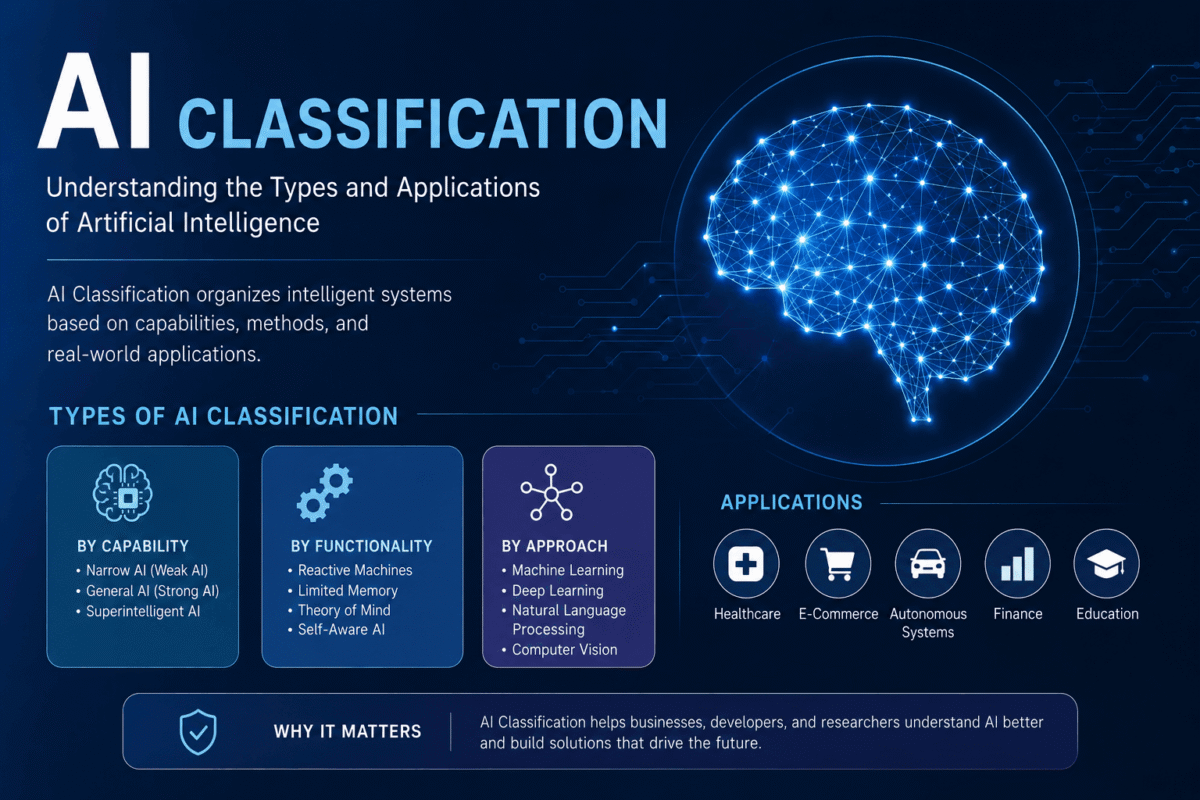
AI Classification: The Complete 2025 Guide to How Machines Learn to Categorize Everything

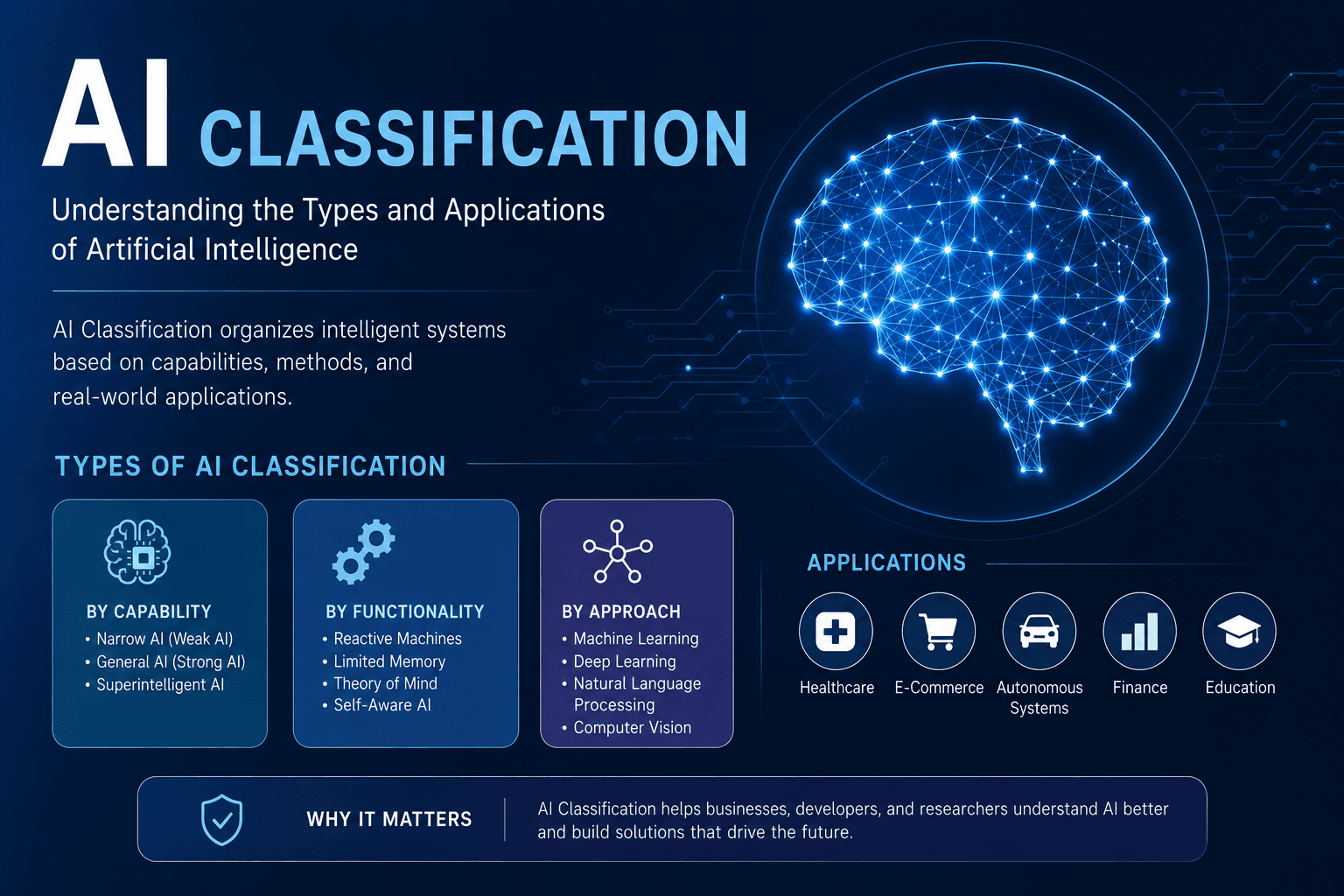
What Is AI Classification? A Clear Definition
At its core, AI classification is the task of teaching a machine learning system to automatically assign a predefined label or category to a given input. That input could be a block of text, a photograph, a medical scan, a transaction record, an audio file — virtually any form of structured or unstructured data. The system learns to make these assignments not through explicit programming of rules, but by detecting patterns hidden inside vast quantities of training examples.
In the language of machine learning, AI classification is one of the most fundamental supervised learning tasks. Given a training dataset where every example has already been labeled by humans, the model learns a mapping function — a mathematical relationship — between the input features of each example and its corresponding output class. Once trained, this function generalizes: it can predict the correct label for entirely new, unseen data with impressive accuracy.
The plain-English version: imagine sorting a pile of letters into "personal," "bills," and "junk mail." AI classification automates exactly this kind of sorting — for any category system, at any scale, far faster than any human team could manage.
The concept sounds simple, but the execution touches some of the most sophisticated mathematics in computer science: optimization theory, linear algebra, probability, information theory, and, at the frontier, the architecture of billion-parameter neural networks. What began as simple statistical categorization in the 1950s is today the backbone of voice assistants, medical diagnostics, financial fraud prevention, and the content moderation systems that govern billions of daily social media interactions.
Understanding AI classification is not just an academic exercise. Whether you are building your own AI-powered product, evaluating tools for your business, or simply making sense of the technology that increasingly shapes daily life, grasping how classification works — what it can and cannot do — is one of the most practical pieces of AI literacy you can develop in 2025. You can explore a curated list of tools powered by classification technology directly in our AI tools directory.
The Four Primary Types of AI Classification
Not all classification problems look the same. Researchers and engineers have developed distinct frameworks to handle different category structures and real-world complexity. Understanding which type applies to your problem is the first step in choosing the right model, dataset strategy, and evaluation approach.
A Note on Ordinal Classification
Some engineers distinguish a fifth type — ordinal classification — where the classes have a meaningful order (e.g., customer satisfaction rated Low / Medium / High / Very High) but are not numerical in the way that enables regression. Ordinal classifiers exploit this ordering to improve accuracy compared to treating the classes as purely unrelated categorical labels.
The distinction between these types matters enormously in practice. Choosing a binary classifier for a multi-label problem will produce systematically wrong outputs. Building a flat multi-class model when the label space is actually hierarchical wastes information embedded in the taxonomy and produces a classifier that generalizes poorly to rare subcategories.
How AI Classification Actually Works: Step by Step
Behind every AI classifier is a consistent pipeline — a sequence of data transformations and optimization steps that converts raw examples into a decision-making system. Understanding this pipeline demystifies the "black box" and gives you the language to evaluate, debug, and improve any classification model.
Explore AI Tools Powered by Classification Technology
Browse our curated directory of 500+ AI tools — each reviewed, categorized, and rated by the AIToolsTitan team.
Key AI Classification Algorithms Explained
Dozens of algorithms can be applied to AI classification problems. The "best" algorithm depends entirely on your data size, feature structure, interpretability requirements, and latency constraints. Here is a comprehensive comparison of the most widely deployed classifiers in production systems today.
| Algorithm | Best For | Interpretability | Data Size | Training Speed |
|---|---|---|---|---|
| Logistic Regression | Binary classification, baseline | High | Small–Medium | Very Fast |
| Decision Tree | Tabular data, rule extraction | High | Small–Medium | Fast |
| Random Forest | Robust tabular classification | Medium | Medium–Large | Medium |
| XGBoost / LightGBM | Structured data, competitions | Medium | Medium–Large | Fast |
| Support Vector Machine | High-dim, small datasets | Medium | Small–Medium | Medium |
| Naive Bayes | Text classification, spam filters | High | Small–Large | Very Fast |
| k-Nearest Neighbors | Low-dim, small datasets | High | Small | Instant (no training) |
| Multilayer Perceptron | Complex non-linear patterns | Low | Large | Medium |
| Convolutional Neural Net | Image & audio classification | Low | Very Large | Slow (GPU needed) |
| Transformer (BERT, etc.) | NLP text classification | Low | Very Large | Slow (GPU needed) |
A common mistake among beginners is reaching for the most complex algorithm — a large Transformer or deep CNN — regardless of the problem. In reality, on many real-world tabular datasets, a well-tuned XGBoost model outperforms deep learning while training in minutes rather than hours, and producing predictions that can be explained to stakeholders. Always start with the simplest classifier that could plausibly solve the problem, and only escalate complexity when simpler models demonstrably fall short.
Pro tip: The "no free lunch theorem" formally proves that no single algorithm is best for every classification problem. Model selection must be empirical — you have to try multiple approaches on your actual data and compare their performance with proper cross-validation.
Text Classification: Teaching Machines to Read Between the Lines
Text classification is one of the most commercially valuable branches of AI classification. It encompasses any task where the input is a natural language string — a sentence, a paragraph, a document, a social media post — and the output is a discrete label. The scope of production text classifiers running right now, quietly and invisibly, is staggering.
How Text Gets Turned Into Numbers
A neural network cannot process raw text. It needs numbers. The transformation pipeline has evolved dramatically over the past decade. Early approaches used Bag-of-Words (BoW) representations — a vector counting how many times each vocabulary word appears in the document, discarding word order entirely. TF-IDF improved this by downweighting common words and upweighting rare, information-rich terms.
Word embeddings like Word2Vec and GloVe introduced the idea of dense vector representations where semantically similar words cluster in geometric space — "king" and "queen" are close together; "cat" and "automobile" are far apart. Recurrent Neural Networks (RNNs) and then Long Short-Term Memory (LSTM) networks were trained over these embeddings, finally allowing text classifiers to account for word order and long-range dependencies.
The modern standard is the Transformer architecture, introduced in the landmark 2017 paper "Attention Is All You Need." Models like BERT, RoBERTa, DistilBERT, and their successors learn rich, context-aware representations of text through pretraining on billions of words, then can be fine-tuned for any specific text classification task in hours with a relatively small labeled dataset. This transfer learning paradigm has made high-accuracy text classification accessible to teams without million-token annotation budgets.
Critical Text Classification Applications
Image Classification: How AI Learned to See
Image classification is the task of assigning a label to an entire image. It is the foundation of computer vision and arguably the application area that triggered the modern deep learning revolution. When AlexNet — a deep Convolutional Neural Network — won the ImageNet competition in 2012 with an error rate nearly 11 percentage points lower than the next best system, it catalyzed a wave of investment and research that continues to compound today.
A Convolutional Neural Network (CNN) processes an image through successive layers of learned filters. Early layers detect edges and textures. Intermediate layers detect shapes and parts. Deep layers detect objects and scenes. This hierarchical feature extraction — learned entirely from labeled data — matches and in many domains exceeds human-level accuracy at classifying images.
Key Architectures in Image Classification
AlexNet was followed by VGGNet (deeper, simpler), GoogLeNet/Inception (parallel filter paths), and ResNet (skip connections enabling very deep networks without vanishing gradients). EfficientNet introduced compound scaling — simultaneously scaling network width, depth, and resolution — to achieve state-of-the-art accuracy with dramatically fewer parameters. Vision Transformers (ViTs) now challenge CNNs on large-scale benchmarks by applying the Transformer attention mechanism directly to image patches.
Transfer Learning Makes Image Classification Affordable
Training a ResNet-50 from scratch on a million images requires substantial compute and data. But thanks to transfer learning, you can download weights pretrained on ImageNet and fine-tune the final layers on just a few hundred domain-specific images in hours on a single GPU. This is how startups build accurate medical imaging classifiers, agricultural disease detectors, and quality control vision systems without billion-parameter training budgets.
Real-world benchmark: ResNet-152 achieves a top-5 error rate of approximately 4.5% on the ImageNet validation set. Human performance on the same benchmark is approximately 5.1% — meaning the AI classifier is statistically more accurate than an expert human labeler on this particular task.
Find the Right AI Classification Tool for Your Use Case
Our listings directory covers image classifiers, NLP tools, multi-modal AI platforms, and dozens more — all with hands-on reviews and affiliate-verified ratings.
Real-World Use Cases of AI Classification Across Industries
AI classification has moved decisively from academic benchmarks into production systems that process billions of events daily. The following examples span industries to illustrate the breadth of where classification-powered AI creates measurable economic value.
Deep Learning vs. Traditional ML for Classification: An Honest Comparison
The explosion of deep learning hype over the past decade has created a persistent misconception: that neural networks are always the superior choice for AI classification. The reality is considerably more nuanced, and choosing the wrong paradigm for your data type and size is one of the most common engineering mistakes in applied ML projects.
- Dominates on unstructured data: images, audio, raw text at scale
- Learns features automatically — no manual feature engineering needed
- Transfer learning enables high accuracy with limited labeled data
- Continues improving as data volume increases indefinitely
- State-of-the-art results on almost every major benchmark
- Requires GPU compute and significantly longer training time
- Opaque decision-making — poor interpretability by default
- Often matches deep learning on small-to-medium tabular datasets
- Extremely fast training — seconds to minutes on a CPU
- Interpretable: decision paths, feature importances are explainable
- Requires carefully engineered features to perform well
- Performance plateaus quickly as data volume scales
- Struggles with raw images, audio, and long-form text natively
- XGBoost/LightGBM remain competitive in production for tabular data
The pragmatic answer for most teams: start with gradient-boosted trees (XGBoost or LightGBM) on any structured tabular data problem. They are fast to train, easy to interpret, and frequently match deep learning performance. Move to neural networks when you are working with images, audio, or text; when your dataset has hundreds of thousands or millions of examples; or when the tabular models have demonstrably plateaued and you have the compute budget to scale up.
For text classification specifically, fine-tuning a pretrained Transformer like BERT has become the default modern approach for any reasonably resourced team, because the economics of transfer learning make it accessible even at small label set sizes of a few hundred examples per class.
How to Measure AI Classification Performance: The Metrics That Matter
Selecting the right evaluation metric is as important as selecting the right algorithm. "Accuracy" — the percentage of correctly classified examples — sounds intuitive but is deeply misleading for imbalanced datasets. A classifier that predicts "not fraud" for every transaction in a dataset where 99.5% of transactions are legitimate achieves 99.5% accuracy while being completely useless for its intended purpose of finding fraud.
| Metric | Definition | When to Prioritize It |
|---|---|---|
| Accuracy | Correct predictions ÷ Total predictions | Only when classes are balanced |
| Precision | True Positives ÷ (True Positives + False Positives) | When false alarms are costly (spam filter) |
| Recall (Sensitivity) | True Positives ÷ (True Positives + False Negatives) | When missing a positive is costly (cancer detection) |
| F1 Score | Harmonic mean of Precision and Recall | When both precision and recall matter equally |
| AUC-ROC | Area under Receiver Operating Characteristic curve | Ranking ability across all decision thresholds |
| Cohen's Kappa | Agreement adjusted for chance | Multi-class with class imbalance |
| Confusion Matrix | Full breakdown of TP, TN, FP, FN per class | Always — the foundational diagnostic tool |
The Precision-Recall Trade-Off
Most classification models produce a probability score (e.g., "73% likely spam") rather than a hard label. A decision threshold converts this score into a binary classification. By adjusting this threshold, you can trade precision for recall — moving the threshold down catches more true positives (higher recall) but also more false positives (lower precision). The precision-recall curve and its area (AUC-PR) capture this trade-off comprehensively. For highly imbalanced datasets, AUC-PR is generally more informative than AUC-ROC, which can be overly optimistic when the negative class dominates.
The choice of which metric to optimize should be driven by the cost asymmetry of the deployment context. In medical screening for a serious disease, a false negative (missed diagnosis) may be catastrophic while a false positive merely triggers additional testing — meaning you optimize for recall even at the expense of precision. In email spam filtering, an aggressive classifier that silences legitimate business emails (false positives) destroys user trust — meaning precision is the priority metric.
Challenges and Limitations of AI Classification Systems
Despite remarkable progress, AI classification systems face real, unsolved challenges that every practitioner must understand before deploying them in production. Ignoring these challenges leads to systems that perform well in testing and fail dangerously in the real world.
The Future of AI Classification: What's Next
AI classification is not a static field. The frontier is moving rapidly, with several paradigm shifts already in progress that will reshape what classification systems can do, how they are built, and what resources they require.
Foundation Models and Zero-Shot Classification
The most significant shift is the rise of large foundation models — pretrained on diverse, web-scale data — that can perform classification without any task-specific fine-tuning. OpenAI's CLIP model, for example, can classify images into any user-defined category by comparing image embeddings to text embeddings of category descriptions, without having ever been trained on those specific categories. This "zero-shot classification" capability dramatically reduces the cost of deploying classification systems to new domains.
Large language models like GPT-4, Claude, and Gemini extend this to text classification: given a system prompt defining the classification task and a user message containing the document to classify, these models produce accurate labels without fine-tuning. For many practical classification tasks, prompt-based LLM classification now competes with fine-tuned specialist models while requiring no training data and deploying instantly.
Multi-Modal Classification
Modern classification increasingly fuses multiple data modalities — combining text, image, audio, tabular data, and video within a single unified model. Multi-modal classifiers can make decisions that neither a pure text classifier nor a pure image classifier could match. Medical AI systems that classify disease severity by jointly analyzing clinical notes, lab values, and radiology images achieve accuracy that single-modality models cannot reach.
Self-Supervised and Contrastive Learning
Self-supervised pre-training — where models learn representations from unlabeled data by predicting masked parts of their input or by contrasting similar and dissimilar examples — is reducing the labeled data requirement for downstream classification dramatically. Meta's DINO and SimCLR demonstrate that high-quality visual classifiers can be developed with far less manual annotation than previously required.
Federated Learning for Privacy-Preserving Classification
Federated learning trains classification models collaboratively across many devices or institutions without centralizing sensitive data. Each participant trains locally; only model updates (gradients), not raw data, are shared. This enables medical AI consortia to build shared classification models across hospital networks without any institution sharing patient data — a critical capability for healthcare AI adoption in a post-GDPR regulatory environment.
The trajectory is clear: AI classification is becoming cheaper to build, more accurate at every data scale, more capable on novel categories without training, and increasingly accessible to small teams and individual developers. If your product domain involves categorizing anything at scale — text, images, behaviors, events — classification AI either already powers a competitor's product or will within two years. Explore the state of the art in our AI tools directory to find the tools already implementing these capabilities today.
Frequently Asked Questions About AI Classification
Here are the most common questions we receive about AI classification, answered clearly for beginners and practitioners alike.