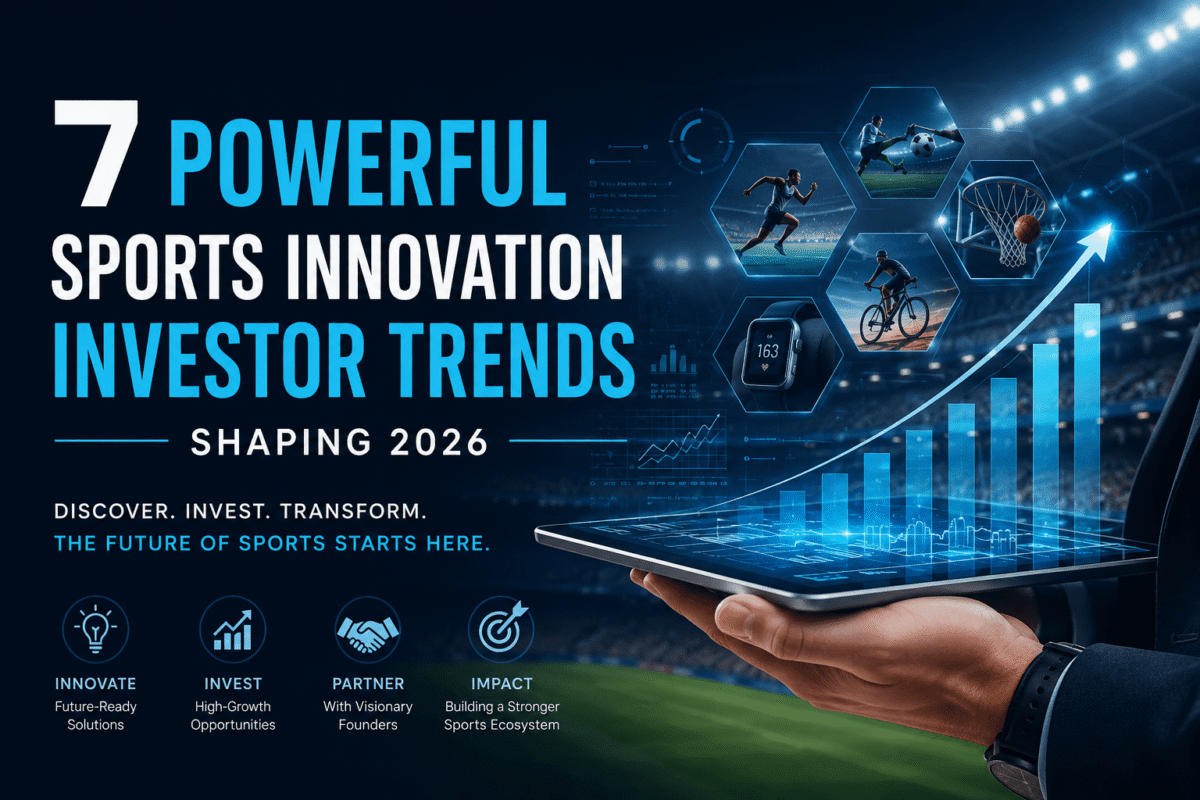
7 Smart AI Sports Innovation Investor Ideas Driving Billion-Dollar Deals


Want the full player-level breakdown? Read our flagship analysis: AI Sports Analytics — Tua Tagovailoa 2025 Deep Dive — covering how machine learning models are evaluating elite NFL quarterbacks in real time.
What Is Sports Innovation Investor?
Sports Innovation Investor is one of the most actively curated, AI-powered news trackers in the global sports technology landscape. Hosted on NBot.ai — a personalized AI content-tracking platform — this feed was built by Miguel Ángel Hernández and has published over 618 posts spanning the three most commercially significant pillars of modern sports business: analytics, fan experience, and wearable performance data.
Unlike passive news aggregators that rely on keyword RSS feeds, Sports Innovation Investor uses an autonomous AI agent to continuously scan the open web for relevant signals — funding announcements, product launches, regulatory developments, and broadcast technology shifts — and automatically organizes every find into a clean, investor-grade daily digest updated within 24 hours of publication.
Sports Innovation Investor
Global sports business analytics, fan experience tech, and wearable performance insights — AI-curated daily since 2025.
The Sports Innovation Investor feed is a trusted reference point for venture capitalists, broadcast engineers, sports team executives, and digital media professionals who need to stay ahead of the fastest-moving market in the technology sector. Recurring coverage themes include AI broadcasting infrastructure, prediction market regulation, AR/VR hardware funding, fan data commercialization strategies, and real-time player performance intelligence.
For a deeper look at how AI is being applied at the individual player level — including elite NFL quarterback analysis — see our related deep dive: AI Sports Analytics: Tua Tagovailoa 2025 Deep Dive .
AI Sports Analytics Market Size 2026: The Numbers That Define the Decade
The global AI in sports market has crossed the threshold from early adoption into mainstream institutional deployment. Multiple independent research reports published in 2025–2026 confirm that we are entering the steepest part of the growth curve, driven by simultaneous adoption pressure across professional leagues, broadcasters, wearable manufacturers, and sports betting operators.
Machine learning models can now predict game winners with 70–80% accuracy — levels that match or exceed expert human analysts. The global sports analytics market is projected to exceed $22 billion by 2030, driven largely by AI adoption across the NBA, NFL, and Premier League.
— WSC Sports Research, February 2026The Global SportsTech Report by SportsPro and Sportradar, which surveyed 160+ senior sports executives globally, confirmed that more than 80% of sports organizations now actively use AI — and virtually every adopter plans to increase investment within 12 months. This is not a pilot-stage statistic; it reflects a fundamental shift in how professional sports operates.
The fantasy sports segment adds another layer to this opportunity: the global fantasy sports market is forecast to grow from $40.66 billion in 2026 to $116.78 billion by 2034, at a 14.1% CAGR — creating enormous downstream demand for AI-powered player analytics, injury prediction, and real-time performance data.
Three Core Technology Pillars of Sports Innovation Investor Coverage
An analysis of the Sports Innovation Investor tracker's 618+ posts reveals three dominant technology categories that attract the highest coverage frequency, the largest capital flows, and the most active regulatory scrutiny heading into the second half of 2026:
AI-Powered Performance Analytics
Real-time player monitoring, computer vision match analysis, injury prediction models, and tactical AI decision tools deployed at the professional level across NFL, NBA, EPL, F1, and tennis circuits.
Fan Experience Technology
Personalized DTC streaming, AR/VR stadium overlays, AI-generated highlight reels, fan data commercialization platforms, and prediction market integrations that transform passive viewers into active participants.
Wearable Performance Insights
IoT-enabled biometric data pipelines delivering fatigue detection, load management analytics, HRV recovery scoring, and real-time broadcast overlays for elite athletes across every major sport.
According to MobiDev's sports technology trend report (March 2026), wearable sensors and AI analytics currently dominate capital spending due to their measurable, direct impact on athlete longevity and performance output. Meanwhile, direct-to-fan platforms are unlocking revenue streams that simply did not exist in the previous decade.
Fan Experience Technology: AI Turns Loyalty Into Revenue
Sports organizations have historically treated fan loyalty as a soft asset — measurable only in ticket sales and jersey revenue. In 2026, the Sports Innovation Investor tracker has documented a decisive shift: leading teams and leagues now treat fan data as their most undervalued commercial asset, building technology infrastructure to monetize every touchpoint from mobile app engagement to in-stadium IoT interactions.
ATP Media Tennis TV — The AI Personalization Blueprint
ATP Media's upgraded Tennis TV application uses WSC Sports AI to auto-detect players throughout practice sessions and warm-ups — not just match play — and assembles personalized highlight packages for individual fans based on their viewing history. Vertical content is generated automatically for mobile-first consumption. This is the clearest live case study for AI-powered DTC fan engagement at scale in 2026.
Smart Stadiums: From Concrete to Connected Infrastructure
AI-powered smart stadiums are deploying IoT sensor networks that monitor crowd density, optimize concession queue routing, manage dynamic pricing, and run real-time threat detection using computer vision. The result is a fan experience that is simultaneously safer, more efficient, and more personalized than any previous generation of stadium technology.
AR/VR: Hardware Costs Finally Approaching Mass-Market Viability
Snap's acquisition of Illumix — integrating its spatial AR mapping into the Specs smart glasses platform — and Phosio's $4M seed round targeting affordable thin-film AR lenses both signal the same thesis: the hardware cost barrier preventing mass consumer AR adoption in sports is being systematically dismantled. Snap reported 28% year-on-year lens growth, confirming commercial traction, not just hype.
| Technology | Leading Company | Stage | Commercial Impact |
|---|---|---|---|
| AI Highlight Generation | WSC Sports | Live | Personalized DTC content pipelines |
| AR Smart Glasses | Snap / Phosio | Scaling | Immersive live match experience layer |
| Prediction Markets | Kalshi / SpeedLabs | Regulatory Review | New real-time in-game wagering products |
| Fan Data Platforms | Multiple Startups | Emerging | Fan loyalty monetization at scale |
| AI Broadcasting | NBC Sports / Fox | Live | AI voice, cloud remote production |
Wearable Performance Insights: Biometric Intelligence at Game Speed
The wearable performance technology landscape has evolved dramatically beyond fitness tracking into mission-critical infrastructure for elite sports operations. Today's systems generate continuous biometric data streams that feed AI models capable of predicting injury risk days before a player feels symptoms, optimizing training periodization with surgical precision, and generating real-time performance overlays for broadcast audiences.
The Premier League's cloud infrastructure partnership with Microsoft Azure (July 2025) demonstrates how elite organizations are moving toward a unified model: wearable sensor data, tactical video feeds, GPS positional data, and fan engagement metrics all flowing into a single AI-orchestrated platform — eliminating the data silos that previously prevented meaningful cross-domain analysis.
Four High-Value Wearable Analytics Applications in 2026
-
1
Real-Time Musculoskeletal Load Management
GPS vests and inertial measurement units track every sprint, jump, change of direction, and deceleration, generating workload accumulation models that alert coaching staff when an athlete approaches injury-risk thresholds — reducing soft tissue injuries by up to 30% in documented pilot programs across EPL and NBA clubs.
-
2
HRV-Based Daily Readiness Scoring
Heart rate variability wristbands and sleep quality sensors produce individualized readiness scores each morning. AI systems cross-reference these against travel schedules, back-to-back game density, and historical injury patterns to generate personalized training load recommendations for each player — replacing guesswork with evidence.
-
3
Live Broadcast Performance Overlays
Real-time wearable data — top speed, distance covered, heart rate zones, sprint count — is being streamed directly into broadcast graphics packages, giving fans second-screen access to the same biometric data the coaching staff monitors. This creates new sponsor inventory categories that did not exist two years ago.
-
4
Tactical AI Decision Support
Coaches receive in-game alerts on sideline tablets when a player's deceleration patterns, sprint velocity decline, or HRV telemetry suggests cognitive or physical fatigue — enabling data-driven substitution decisions instead of relying on subjective visual assessment from the bench.
For a concrete example of how these wearable insights are applied at the individual quarterback level in the NFL, our deep-dive analysis provides a full breakdown: AI Sports Analytics — Tua Tagovailoa 2025: How Wearables & ML Are Reshaping NFL Evaluation .
AI in Sports Broadcasting: The Traditional Rulebook Is Being Discarded
Sports broadcasting is undergoing its most significant infrastructure transformation since the shift from analogue to HD. The convergence of IP-based production workflows, cloud-native broadcasting platforms, AI-generated commentary, and 5G remote uplinks is eliminating the operational justification for enormous on-site broadcast infrastructure — replacing it with lean, software-defined production systems that can be deployed anywhere in hours and managed from centralized cloud hubs.
Fox Sports' BRISK remote production system — stress-tested at Super Bowl LIX and now deployed across 16 cities for the 2026 FIFA World Cup — packs a complete production studio into six wheeled server racks that connect via IP directly to the Los Angeles headquarters. Set-up time is measured in hours, not days. Real-time GhostFrame and Unreal Engine AR integration delivers visual complexity that rivals fixed studio production at a fraction of the capital cost.
NBC Sports: AI-Generated Commentary Crosses the Broadcast Threshold
NBC Sports' deployment of AI-generated voice technology for NBA programming in 2025 represents a genuine inflection point: for the first time, artificial intelligence is generating the actual spoken broadcast — not just the graphics overlay or the analytics sidebar. The commercial implications for rights holders, talent agencies, and broadcast unions are still being worked through, but the technical capability is now demonstrated at scale.
AI-driven workflows, cloud orchestration, and real-time monitoring are no longer competitive differentiators in sports broadcasting — they are the new operational baseline. Organizations that haven't begun the migration face the same fate as on-premise data centers: obsolescence at the speed of a software release cycle.
— MNC Software / InfoComm 2026 AnalysisPrediction Markets & Sports Betting AI: The $60 Billion Battleground
Prediction markets have expanded nearly 30-fold in under two years, with sports contracts now accounting for 39% of Polymarket volume. This staggering growth rate is simultaneously generating the most commercially exciting product innovation in sports business and attracting the most aggressive regulatory backlash the sector has seen since the passage of PASPA in 1992.
SpeedLabs: AI Creates Wager Categories That Never Existed Before
SpeedLabs, which closed a $6.5 million seed round in June 2026, has launched its Momentum Markets product — an AI engine that generates entirely new in-game betting markets in real time from live match events: injury outcomes, momentum swings, burst scoring runs, and individual player performance thresholds. These are not repriced existing bets. They are categorically new financial instruments that only become possible at the processing speed AI provides, and they represent a fundamental architectural challenge to the traditional sportsbook model.
The Kalshi Lawsuit: Regulatory Reckoning Arrives
The New Mexico Department of Justice's lawsuit against Kalshi (June 2026) is the most significant state-level regulatory challenge yet to the prediction market industry, arguing that sports-event prediction contracts constitute illegal sports wagering under state law regardless of how they are structured at the federal level. The outcome of this case — and the wave of similar state actions it is likely to catalyze — will define the commercial architecture of the entire sector for the next decade.
- AI Sports Predictions 2026 — WSC Sports · 70–80% ML accuracy, market forecasts, methodology
- AI in Sports Market Report 2026–2034 — Fortune Business Insights · $5.01B by 2034, full CAGR analysis
- Global SportsTech Report — SportsPro & Sportradar · 82% AI adoption, 160+ executive survey
- Top 7 Sports Technology Innovations 2026 — MobiDev · Wearables, AR, AI analytics strategic overview
- Top 10 AI Innovations Reshaping Sports 2026 — AI World Today · $27B projection, smart stadiums, fan experience tech
- Sports Innovation Investor Live Tracker — NBot.ai · 618+ posts, daily AI-curated sports business intelligence
- AI Sports Analytics — Tua Tagovailoa 2025 Deep Dive — AIToolsTitan · NFL quarterback AI analysis, player-level wearable insights
Top Sports Tech Investments & Signals Tracked in 2026
Sports Innovation Investor's daily digest surfaces investment signals — funding rounds, corporate POC initiatives, and strategic acquisitions — before they propagate to mainstream sports media. Below are the most commercially significant signals from recent tracker coverage, representing the active frontier of sports technology capital allocation:
| Company | Stage / Round | Focus Area | Strategic Signal |
|---|---|---|---|
| SpeedLabs | $6.5M Seed | AI Prediction Markets | New category: momentum-triggered real-time wagers |
| Phosio | $4M Seed | Consumer AR Glasses | Thin-film platform solves the cost barrier |
| Snap + Illumix | Acquisition | Specs AR Smart Glasses | 28% YoY lens growth — spatial computing bet confirmed |
| IBM Ventures | $500K–$15M POC range | Sports-Specific AI | Fortune 100 capital formally entering sports tech |
| Fantasy Sports Platforms | Market Expansion | DFS / AI Analytics | $40.66B → $116.78B by 2034 (14.1% CAGR) |
| Premier League + Microsoft | Strategic Partnership | Azure AI / Cloud Operations | Full cloud migration for performance, fan data & workflows |
The IBM Ventures sports tech pitch competition held at its Manhattan headquarters in June 2026 is a particularly significant signal: when Fortune 50 innovation labs begin formally structuring minority investment programs ($500K–$15M) specifically for sports technology startups, it indicates the sector has achieved institutional legitimacy that goes far beyond the venture capital community.
How AIToolsTitan Got Featured in Sports Innovation Investor
Our article AI Sports Analytics — Tua Tagovailoa 2025 Deep Dive was automatically scanned and cited as a relevant source within the Sports Innovation Investor tracker on NBot.ai. The citation appeared two days after publication, confirming that NBot.ai's AI crawl cycle operates on near-daily intervals for topically relevant domains.
This represents a natural, organic, high-relevance backlink earned through content quality and topical alignment — exactly the type of citation that signals domain authority to Google's Helpful Content and E-E-A-T evaluation systems. Here is how to replicate and compound this backlink pattern:
-
1
Publish Data-Dense, Statistics-First Content
NBot.ai's AI agent prioritizes content containing original market data, funding figures, and quantitative performance insights. Articles that lead with concrete numbers — market size, CAGR, accuracy percentages — are indexed and cited at a higher rate than editorial-only content.
-
2
Map Your Content to Active Tracker Topics
Browse active trackers at nbot.ai/explore and identify trackers whose stated scope precisely matches your content strategy. Writing articles that are topically dense matches the semantic patterns the NBot AI agent uses when determining citation relevance.
-
3
Maintain a Consistent 2–3x Weekly Publishing Cadence
NBot.ai trackers update on daily cycles. Publishing consistently means your domain appears repeatedly across multiple digest cycles — compounding your citation footprint and establishing AIToolsTitan as a recurring reference source rather than a one-time find.
-
4
Implement Full RankMath SEO + JSON-LD Schema
Proper structured data markup — BlogPosting schema, FAQPage schema, clear heading hierarchy, and optimized meta descriptions — makes your content simultaneously readable to AI crawlers like NBot's agent and to Google, Bing, and Yahoo's indexing systems, maximizing discovery velocity from both automated and organic search channels.
-
5
Build Strategic Internal Link Architecture
Connect related articles with contextually relevant internal links — as we have done throughout this post linking back to our Tua Tagovailoa AI analytics deep dive. Internal linking distributes authority, signals content relationships to search engines, and increases the average pages-per-session metric that correlates with improved rankings.
Frequently Asked Questions — Sports Innovation Investor & AI Sports Analytics
Sports Innovation Investor is an AI-powered news tracker on NBot.ai with 618+ posts covering global sports business analytics, fan experience technology, and wearable performance insights. Created by Miguel Ángel Hernández, it automatically scans the web for relevant sports tech articles and delivers a curated daily digest covering venture capital, AI broadcasting, prediction markets, and more.
The global AI in sports market is valued at $7.63 billion in 2025 and projected to reach $27 billion by 2030 at a 28.69% CAGR. Sports betting AI specifically is forecast to grow from $10.8 billion in 2025 to over $60 billion by 2034. Over 82% of professional sports organizations now actively use AI, according to the Global SportsTech Report by SportsPro and Sportradar (February 2026).
The tracker covers AI-powered player performance analytics, sports venture capital funding rounds, AR/VR hardware innovation, fan data monetization platforms, real-time prediction markets and sports betting AI, cloud-based sports broadcasting infrastructure, wearable sensor technology, and smart stadium IoT deployments. It is updated daily and scans approximately 12 articles every 24 hours.
Machine learning models now achieve 70–80% game-winner prediction accuracy, matching or exceeding expert human analysts, according to WSC Sports research. These models integrate historical performance data, real-time biometrics, weather conditions, lineup changes, travel schedules, and historical matchup patterns simultaneously — a multi-variable analysis impossible for any human analyst to replicate at speed and scale.
AIToolsTitan's article on AI Sports Analytics and Tua Tagovailoa was automatically discovered and cited by NBot.ai's AI crawler within two days of publication. The tracker's AI agent identified the article as topically relevant to sports business analytics and included it as a referenced source in the Sports Innovation Investor digest — an organic citation earned through content quality and topical alignment rather than outreach.
The full analysis is published at AI Sports Analytics — Tua Tagovailoa 2025 Deep Dive on AIToolsTitan. It covers how machine learning models evaluate NFL quarterback performance in real time, including wearable biometric integration, computer vision analysis, and predictive injury modeling at the individual player level.